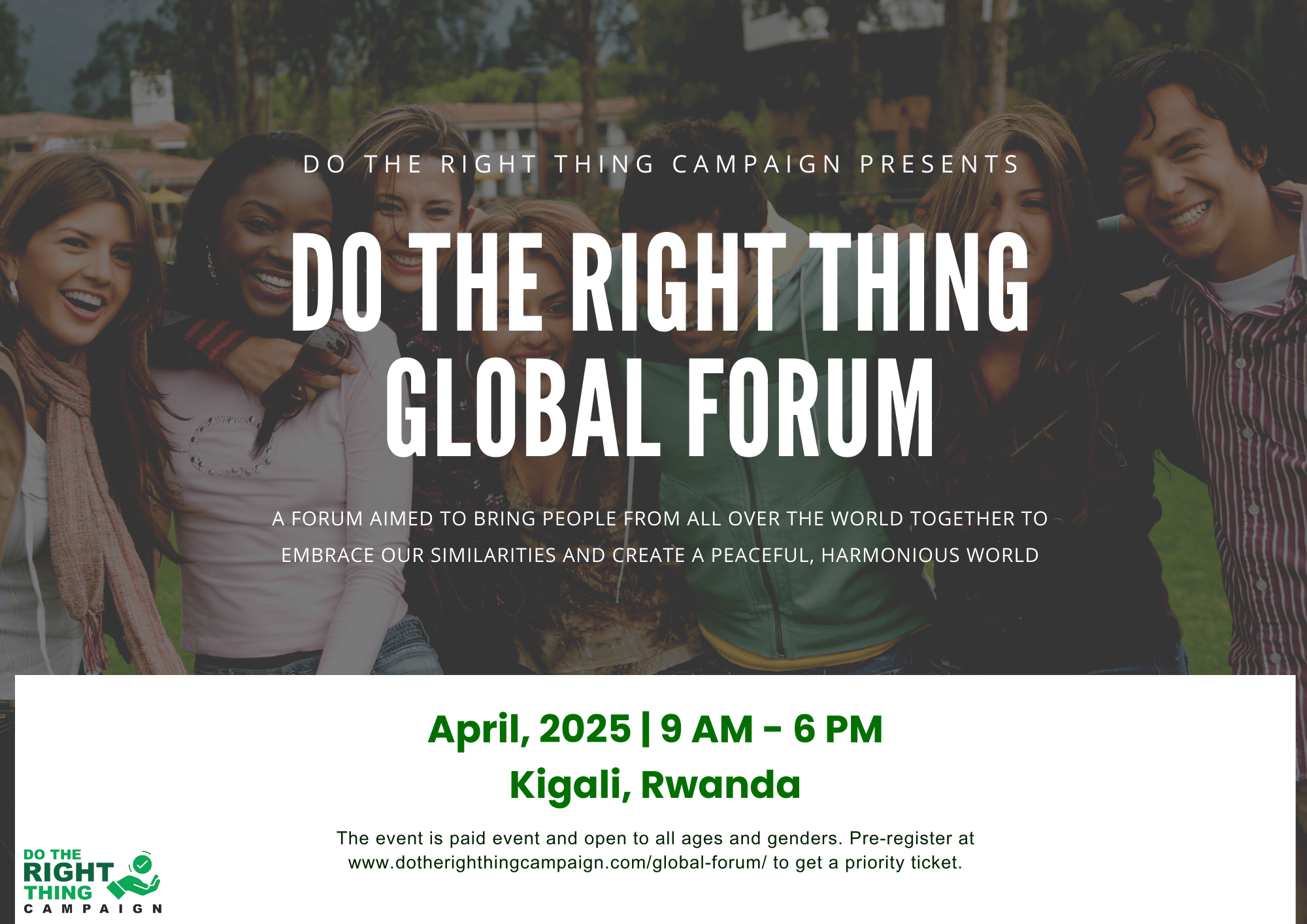



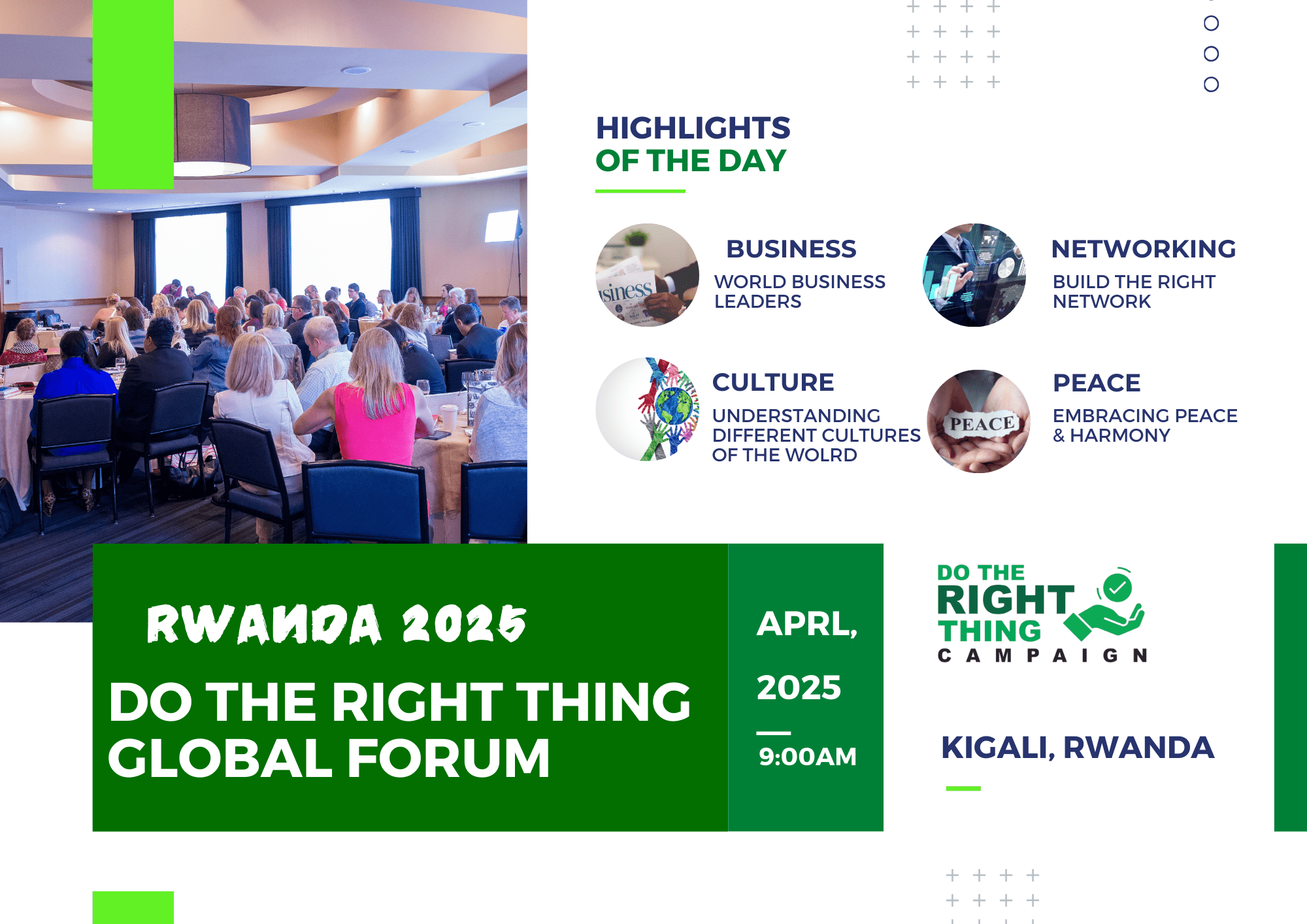
The global forum will provide a platform for discussion, collaboration, and learning
The Do the Right Thing Global Forum is an international event that brings together people from all over the world to discuss issues of love, understanding, and harmony. Through panel discussions, workshops, and other interactive activities, participants will share ideas about how to promote peace and goodwill among all people, regardless of their race, religion, or background.
The goal of the forum is to create a platform for dialogue and understanding, and to inspire action in the pursuit of a more harmonious world.
In 2025, Rwanda is set to host the Do The Right Thing Global Forum, an international gathering aimed at addressing some of the most pressing global challenges in business, culture, social justice, equity, human empowerment and rights of every individual on earth irrespective of race or identity. The forum, inspired by the vision of the Do The Right Thing Campaign, will bring together world leaders, activists, academics, and young change-makers to explore actionable solutions for issues such as racial injustice, economic disparity, climate change, and inclusive governance.

Why Rwanda
Rwanda’s selection as the host country for the 2025 edition of the Do The Right Thing Global Forum is both symbolic and strategic. After the horrific genocide in 1994, Rwanda has transformed itself into a beacon of resilience, unity, and progress. The country’s focus on reconciliation and social harmony after one of the darkest periods in modern history mirrors the forum’s core message: the importance of doing what is right, even in the face of seemingly insurmountable challenges.
President Paul Kagame’s administration has prioritized national healing, equitable development, and women’s empowerment. Rwanda’s remarkable economic growth and its status as one of the most gender-equal nations in the world underscore its role as an ideal setting for this global conversation. The forum’s organizers hope that the Rwandan example will inspire participants to reflect on how the lessons of reconciliation and rebuilding can be applied in their own countries.
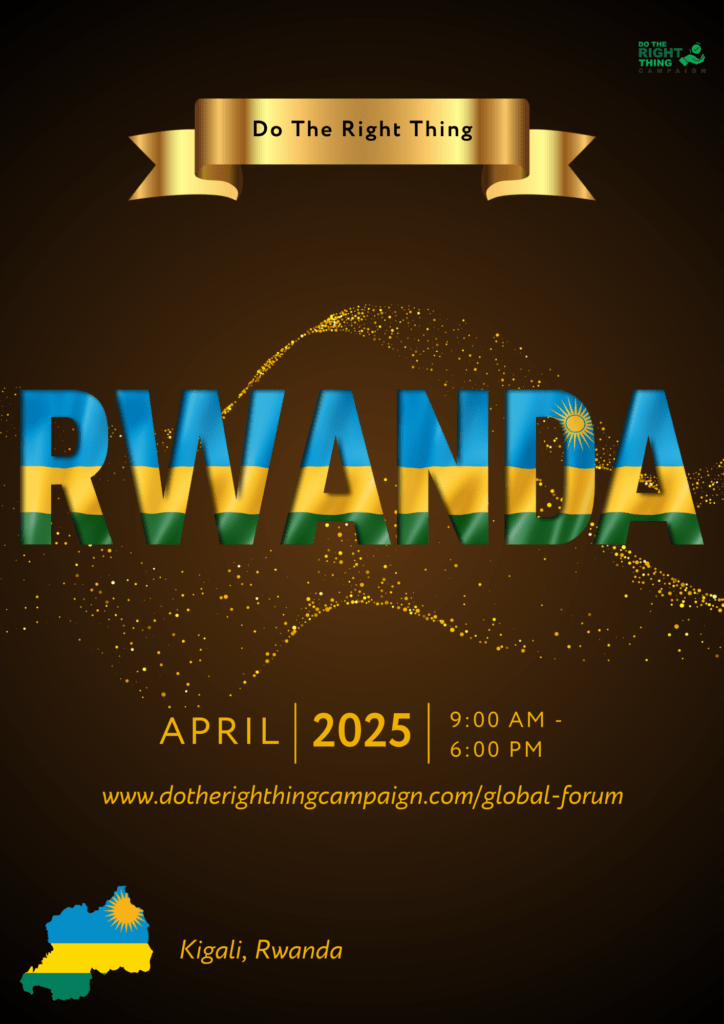
In 2025, Rwanda will host the highly anticipated Do The Right Thing Global Forum, a gathering of global leaders, activists, policymakers, and business pioneers to address issues of social justice, equity, and sustainable economic development. As part of this landmark event, the role of business in driving positive societal change will take center stage, focusing on how enterprises can contribute to solving pressing global challenges such as inequality, climate change, and economic disparity.
This forum, inspired by the Do The Right Thing Campaign Organization, seeks to highlight how businesses can “do the right thing” by embracing responsible practices that benefit not only shareholders but also employees, communities, and the environment.
At the heart of the forum is the recognition that businesses have a critical role in shaping fairer and more equitable societies. Traditionally, corporations have been driven by profit maximization, often at the expense of social and environmental considerations. However, the 2025 Do The Right Thing Global Forum will challenge this outdated model, encouraging companies to embrace principles of corporate social responsibility (CSR), sustainability, and equitable economic practices.
One of the forum’s primary goals is to promote ethical business models that prioritize the well-being of all stakeholders. Leading companies and entrepreneurs will present their approaches to embedding ethical decision-making into their corporate strategies. Topics will include transparent supply chains, responsible sourcing, fair labor practices, and the elimination of exploitative working conditions.
Key discussions will highlight how businesses can avoid perpetuating systemic inequalities by actively supporting marginalized communities through fair wages, inclusive hiring practices, and equitable workplace policies. In this context, companies will be encouraged to reimagine their roles as drivers of positive social change rather than mere economic entities.
Economic inequality, a growing global concern, will be a central topic of discussion at the forum. Despite the wealth generated by globalization, many communities around the world remain trapped in poverty, with growing disparities between the rich and the poor. The forum will delve into how businesses can help address these inequalities through fair wage policies, inclusive supply chains, and equitable economic development.
Several sessions will focus on inclusive business models, which aim to integrate low-income communities into the value chain. From sourcing materials to creating jobs, these models prioritize the empowerment of disadvantaged groups. For example, companies in the agricultural, textile, and renewable energy sectors have shown that inclusive business models can generate both profit and social impact by providing opportunities to those at the base of the economic pyramid.
Attendees will explore how multinational corporations can partner with local businesses and entrepreneurs in developing countries, creating opportunities for those who have historically been left out of the global economic system. By sharing best practices, companies will be encouraged to embrace inclusivity not just as a CSR initiative, but as a core part of their operational strategy.
The Do The Right Thing Global Forum in Rwanda will attract high-profile business leaders, entrepreneurs, and investors who are shaping the future of ethical and inclusive business. Key speakers will include:
- Paul Polman, former CEO of Unilever and co-founder of Imagine, a social venture focusing on sustainable business practices.
- Strive Masiyiwa, founder of Econet Global, who will discuss the role of African entrepreneurs in driving economic transformation and social impact.
- Yvonne Aki-Sawyerr, Mayor of Freetown, who has championed public-private partnerships in tackling urban challenges in Africa.
- Alhaji Aliko Dangote: Aliko Dangote is a Nigerian businessman and industrialist. He is best known as the founder, chairman, and CEO of the Dangote Group, the largest industrial conglomerate in West Africa. He is the first man who built a private refinery in Nigeria
- Mukesh Ambani: Mukesh Dhirubhai Ambani is an Indian businessman and the chairman and managing director of Reliance Industries. With an estimated net worth of $123.3 billion as of July 2024, he is the richest person in Asia and 11th richest in the world.
- Femi Otedola: Olufemi Peter Otedola CON is a Nigerian businessman and philanthropist. He is the former chairman of Forte Oil PLC, and is the current executive chairman of Geregu Power PLC.
- Mr. Allen Onyema: Allen Ifechukwu Onyema CON (born 1964) is a Nigerian lawyer and entrepreneur. He is the Chief Executive Officer of Air Peace Limited.
- Mr. Obinna “Obi” Iyiegbu: best known as Obi Cubana, is a Nigerian businessman, socialite, entertainer and philanthropist. He currently chairs the Cubana Group.
- Akinwumi “Akin” Adesina CON: Akinwumi “Akin” Adesina CON is a Nigerian economist, who is currently serving as the President of the African Development Bank. He previously served as Nigeria’s Minister of Agriculture and Rural Development.
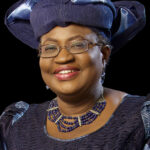
- Ngozi Okonjo-Iweala GCON: Ngozi Okonjo-Iweala GCON is a Nigerian economist, who has been serving as the Director-General of the World Trade Organization since March 2021. She is the first woman and first African to lead the World Trade Organization as Director-General.
These leaders, along with others from a wide array of industries, will offer insights into how businesses can align their goals with broader social and environmental objectives.
- Kofi Annan Foundation representatives, who will share insights on peacekeeping and conflict resolution from the perspective of the United Nations.
- Rwanda’s President Paul Kagame, who will reflect on Rwanda’s post-genocide recovery and its contributions to peace in Africa and beyond.
- Leymah Gbowee, the Nobel Peace Prize-winning Liberian peace activist, who led a nonviolent movement that helped end Liberia’s civil war.
- Archbishop Desmond Tutu (via video or legacy message), reflecting on his role in South Africa’s Truth and Reconciliation Commission and the importance of forgiveness in building peace.
- Abdulsalami Abubakar GCFR: Abdulsalami Abubakar GCFR is a retired Nigerian army general who served as the military head of state of Nigeria from 1998 to 1999. He was also Chief of Defence Staff from 1997 to 1998. He succeeded General Sani Abacha upon the latter’s death and he has been a pioneer and advocate of Peace in Nigeria since Nigeria’s Democracy.
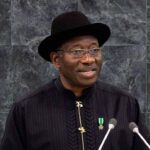
- Goodluck Ebele Jonathan GCFR GCON: Goodluck Ebele Azikiwe Jonathan GCFR GCON is a Nigerian politician who served as the president of Nigeria from 2010 to 2015, he is the founder of the Goodluck Ebele Jonathan Foundation, an NGO that promotes Peace and Unity in Africa and the world at large.
These leaders will inspire participants with stories of resilience, hope, and the enduring human capacity to overcome hatred and division.
Art has long been a medium for challenging oppressive systems, advocating for rights, and shedding light on injustices. At the Do The Right Thing Global Forum, this role of art in promoting social justice will be thoroughly explored. Artists from around the world will share their work, which confronts issues such as racism, sexism, colonialism, and inequality.
Sessions will focus on how visual arts, music, theater, and literature have been used to challenge entrenched power structures and inspire movements for justice. For example, art movements like Black Lives Matter have used murals, street art, and performances to draw attention to racial injustice and police brutality. Likewise, feminist art has long challenged patriarchal norms and fought for women’s rights and gender equality.
Discussions will also explore the role of art in addressing historical wrongs, such as colonialism and slavery. Artists from formerly colonized countries, particularly in Africa, Asia, and Latin America, will showcase their work that reclaims indigenous identities, critiques imperialist legacies, and redefines cultural narratives in a post-colonial world.
One of the core themes of the forum will be how cultural practices can serve as a catalyst for healing in societies recovering from trauma and conflict. In Rwanda, art and culture have been pivotal in the country’s post-genocide reconciliation process. Music, dance, storytelling, and other cultural forms have been instrumental in helping Rwandans mourn their losses, confront the painful memories of the genocide, and rebuild trust between communities.
The forum will highlight similar case studies from other conflict-affected regions, such as Bosnia, South Africa, and Colombia, where cultural initiatives have played a role in reconciliation. Sessions will explore how traditional practices, such as storytelling, rituals, and memorials, help individuals and communities come to terms with their past, acknowledge shared suffering, and foster a collective sense of healing.
Artists, community leaders, and cultural practitioners will lead discussions on the importance of creating safe spaces for artistic expression in post-conflict societies, where people can openly explore their emotions, trauma, and hopes for the future. In this context, art becomes more than a form of entertainment; it becomes a vital tool for individual and societal healing.
At the forum, the power of storytelling—whether through film, theater, literature, or oral traditions—will be a key theme. Storytelling has a unique ability to humanize complex issues, foster empathy, and create emotional connections across cultural and social divides.
The forum will feature screenings of films from across the world that tackle issues of justice, conflict, and reconciliation. Spike Lee’s Do The Right Thing, the film that inspired the forum, will be a focal point for discussion. The film, which portrays racial tensions in a Brooklyn neighborhood, will serve as a launching pad for conversations about race relations, police violence, and the power of film to provoke critical dialogue.
Filmmakers, writers, and theater practitioners from various cultural backgrounds will participate in panel discussions on how their stories have shaped public perceptions of social issues. They will also explore how storytelling can be a powerful tool for advocacy, raising awareness about marginalized communities, and influencing policy.
The Do The Right Thing Global Forum will attract a diverse range of artists, cultural leaders, and thought leaders from around the world. Key participants will include:
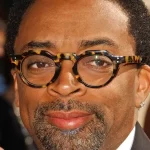
- Spike Lee, the acclaimed filmmaker and director of Do The Right Thing, who will discuss the role of film in raising awareness of social issues and challenging systemic injustice.
- Zanele Muholi, a South African visual activist and photographer, known for documenting the lives of Black LGBTQ+ communities, who will speak on the power of visual storytelling to challenge exclusion and discrimination.
- Angelique Kidjo, the Grammy-winning Beninese singer and activist, who will explore the intersection of music, activism, and social justice in Africa and beyond.
- Wole Soyinka, the Nigerian Nobel laureate and playwright, who will discuss how literature and theater have historically played a role in challenging oppression and inspiring political change.
- Bisade Ologunde Alias Lagbaja: Bisade Ologunde is a Nigerian afrobeat musician, singer-songwriter and percussionist. Widely known as Lágbájá for his signature use of mask which covers his identity. He believes in social reform through music.
These speakers, along with many others, will share their insights and experiences on how art and culture can inspire action and lead to meaningful social transformation.
At the heart of the Do The Right Thing Global Forum, set to take place in Rwanda in 2025, lies a powerful and universally relevant theme: how individuals, communities, institutions, and nations can collectively “do the right thing” in addressing social, economic, and political challenges. Drawing inspiration from Spike Lee’s 1989 film Do The Right Thing, which poignantly explored racial tensions and moral dilemmas in a New York neighborhood, the forum will expand this concept to a global scale, focusing on justice, responsibility, and the pursuit of equality.
By discussing “Do The Right Thing” as a guiding principle, the forum will engage participants from diverse backgrounds to reflect on what it means to act ethically in today’s world, where injustice, inequality, and conflict remain pervasive. The topic will serve as an umbrella for exploring various social issues, from human rights and economic disparities to climate justice, peacebuilding, and the role of global leadership.
The phrase “do the right thing” is rooted in the moral responsibility of individuals and institutions to act justly and fairly, especially when faced with systemic oppression or inequality. The forum will expand this idea by considering the following questions:
- What is the “right thing” for governments, corporations, and global institutions when it comes to addressing poverty, conflict, and social injustice?
- How can individuals, particularly in positions of power, ensure they are making ethical decisions that promote the common good rather than their own interests?
- What does it mean for the global community to “do the right thing” in the face of issues like climate change, mass displacement, and economic inequality?
The forum will invite participants to reflect on these moral and ethical considerations in light of their roles as leaders, activists, or everyday citizens. It will also encourage dialogue on the consequences of inaction or failing to act with integrity, especially when injustice prevails.
Prominent figures from various sectors will lead the discussion on “Do The Right Thing” at the forum. Notable speakers will include:
- Spike Lee, the filmmaker whose work inspired the forum, reflecting on how storytelling can highlight moral dilemmas and provoke social action.
- Paul Kagame, President of Rwanda, who will share insights into how Rwanda has embodied the principles of justice and reconciliation since the genocide.
- Human rights activists and ethicists from global organizations, who will explore the role of global institutions in ensuring that nations and leaders act ethically in the face of global crises.
- Chief Olusegun Obasanjo GCFR: Chief Olusegun Matthew Okikiola Ogunboye Aremu Obasanjo GCFR is a Nigerian retired military officer and statesman who served as Nigeria’s head of state from 1976 to 1979 and later as its president from 1999 to 2007.
- Former President Barack Obama: Barack Hussein Obama II is an American politician who served as the 44th president of the United States from 2009 to 2017. As a member of the Democratic Party, he was the first African-American president in U.S. history
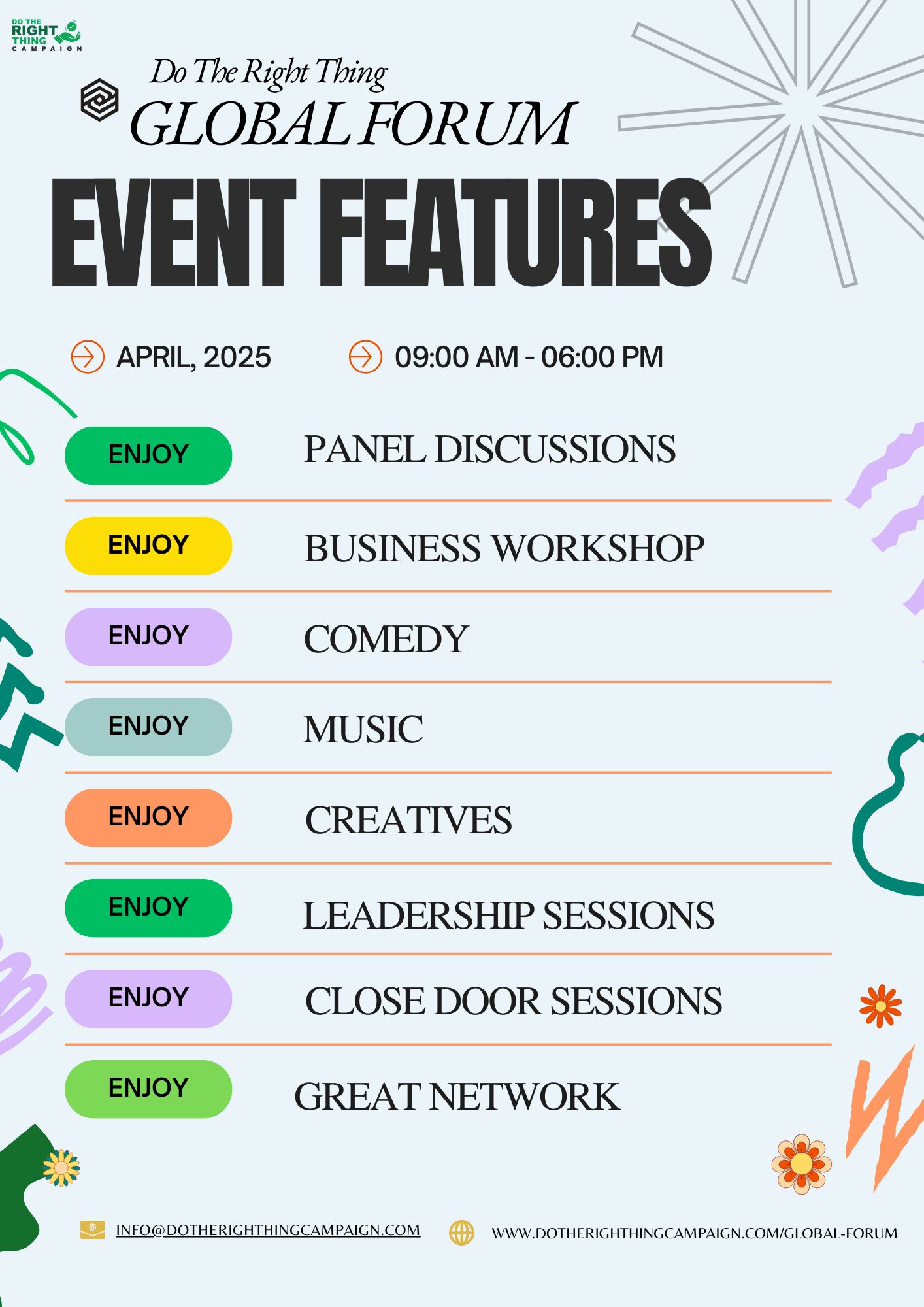
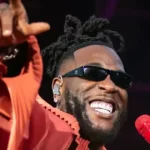
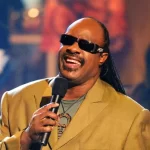
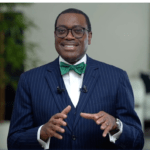
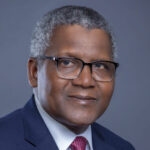
A View of Our Special Guests



Global Sponsors